Telemetry Tech
Introduction
In today’s fast-moving digital world, telemetry tech has become a silent powerhouse—collecting, transmitting, and analyzing real-time data across industries like healthcare, automotive, aerospace, energy, and IoT. Whether it’s monitoring engine performance, smart meters, patients, or satellites, telemetry technology enables smarter decisions, automation, and predictive insights.
This guide breaks down what telemetry tech is, how it works, its applications, and emerging trends shaping the future.
What Is Telemetry Tech?
Telemetry tech refers to the automated process of collecting data remotely and sending it to a central system for monitoring, analysis, and decision-making. It combines sensors, communication networks, analytics, and cloud computing to provide real-time visibility into machines, systems, or environments.
Key Components of Telemetry Technology
- Sensors: Capture real-time metrics such as temperature, pressure, speed, vibration, or biometrics.
- Transmitters: Send the collected data through wireless, satellite, or cellular networks.
- Receivers: Gather and decode incoming information.
- Analytics Systems: Process and visualize the data for actionable insights.
Telemetry is the backbone of IoT devices, smart infrastructure, modern transportation, and industrial automation.
How Telemetry Tech Works
Telemetry systems follow a simple but powerful process:
- Sensors detect changes in the environment or equipment.
- Data is packaged and encoded through microcontrollers.
- Wireless communication (LTE, 5G, satellite, Bluetooth, RF) transmits the data.
- Cloud or on-premise servers process it.
- Dashboards display insights for operators, analysts, and automated systems.
Example: Telemetry in Electric Vehicles
An EV sends telemetry data to the manufacturer including:
- Battery health
- Energy consumption
- Motor temperature
- Charging behavior
This helps improve performance, reduce breakdowns, and enable over-the-air updates.
Applications of Telemetry Tech Across Industries
Telemetry is everywhere—often unnoticed but always essential. Here are leading real-world applications:
1. Automotive & Motorsports Telemetry
Modern cars use telemetry for:
- Fuel efficiency tracking
- Onboard diagnostics
- Predictive maintenance
- Driver behavior monitoring
In Formula 1, teams rely on telemetry to analyze tire temperature, engine status, aerodynamics, and lap performance—transmitted instantly during races.
2. Healthcare Telemetry Systems
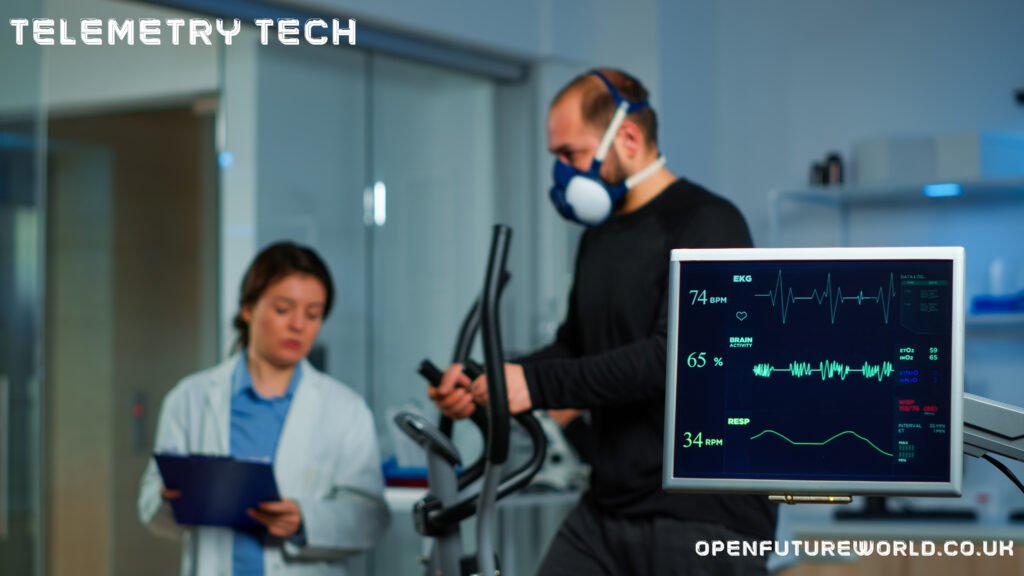
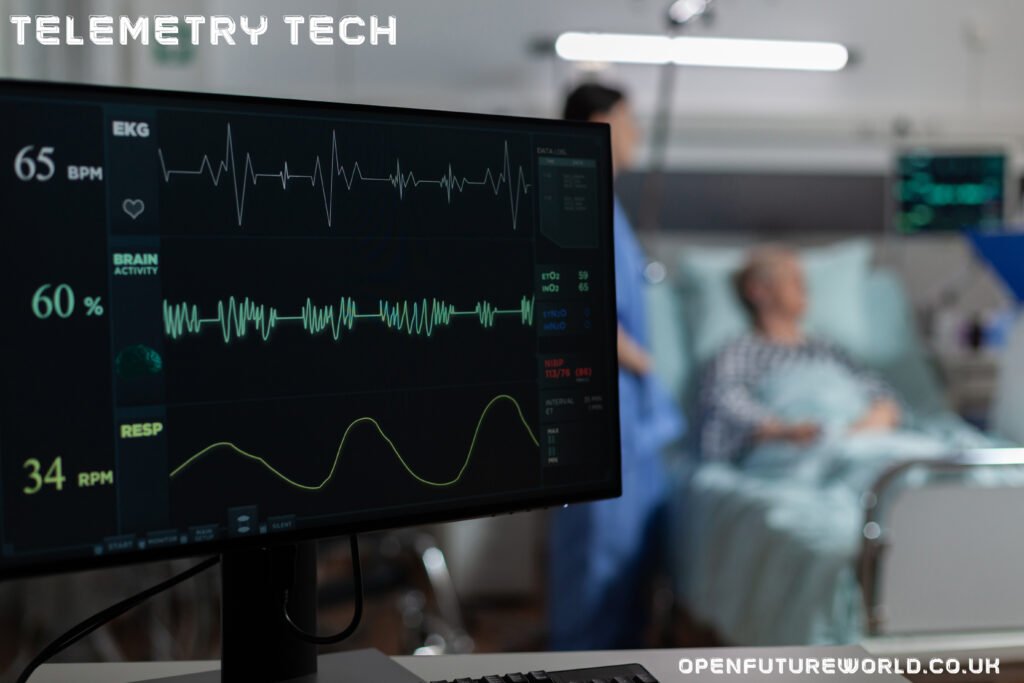
Telemetry medical devices monitor:
- Heart rate
- Blood oxygen
- ECG data
- Movement patterns
This enables remote patient monitoring and early detection of health issues.
3. Aerospace & Satellite Telemetry
Telemetry is crucial for:
- Spacecraft control
- Navigation
- Environmental monitoring
- Flight performance analytics
NASA receives over 1,000+ data points per second from satellites during critical missions.
4. Industrial & Manufacturing Telemetry
Used for:
- Predictive maintenance
- Equipment vibration analysis
- Energy management
- Factory automation
Telemetry reduces downtime by 20–30%, according to industry reports.
5. Utilities: Smart Meters & Grid Management
Smart meters use telemetry to:
- Monitor energy usage
- Detect outages
- Balance grid loads
This supports cleaner, more energy-efficient cities.
6. Agriculture & Environmental Telemetry
Telemetry supports:
- Soil monitoring
- Weather forecasting
- Livestock tracking
- Greenhouse automation
Farmers improve yield while reducing waste.
Benefits of Telemetry Tech
Telemetry delivers high-value advantages:
- Real-time visibility
- Reduced operational costs
- Faster decision-making
- Automation and machine-to-machine communication
- Predictive maintenance
- Improved safety and compliance
Companies using telemetry report up to 40% improved efficiency through automation and monitoring.
Challenges of Telemetry Technology
Despite its benefits, telemetry faces hurdles:
1. Data Security Risks
Massive data transmissions increase vulnerability to cyberattacks.
2. Network Reliability
Remote areas still struggle with connectivity.
3. High Implementation Cost
Sensors, communication modules, and data infrastructure require investment.
4. Data Overload
Telemetry systems generate thousands of data points that require strong analytics.
Future Trends in Telemetry Tech
Telemetry is rapidly evolving with digital innovation:
AI-Powered Telemetry
AI will automate anomaly detection, failure prediction, and smart decision-making.
5G Telemetry Networks (H3)
Ultra-low latency makes real-time data more precise and reliable.
Cloud-Native Telemetry (H3)
Scalable, cost-efficient monitoring for global systems.
Edge Telemetry Processing (H3)
Devices will analyze data locally, reducing bandwidth and speeding decisions.
Digital Twins & Telemetry Integration (H3)
Virtual models will simulate performance based on live telemetry data.
Conclusion: Telemetry Tech Is Shaping a Smarter World (H2)
Telemetry tech is more than just data collection—it’s the foundation of real-time Telemetry Tech: The Future of Real-Time Data Monitoring intelligence in industries worldwide. As AI, 5G, and IoT advance, telemetry will become even more powerful, predictive, and essential.
Want more insights? Read our latest tech guides or contact us today to explore custom solutions.
FAQs
1. What is telemetry in technology?
Telemetry is the automated collection and transmission of data from remote sources to central systems for monitoring and analysis.
2. How is telemetry used in cars?
Cars use telemetry for engine diagnostics, fuel efficiency, driver behavior monitoring, and predictive maintenance.
3. What industries rely most on telemetry?
Healthcare, automotive, aerospace, energy, manufacturing, and agriculture.
4. What is the difference between IoT and telemetry?
IoT involves interconnected devices, while telemetry is the data transmission process that powers IoT systems.
5. Is telemetry data secure?
Telemetry can be secure with encryption, authentication, and protected network protocols.